

Interest rate swaps may be used to alter the interest rate characteristics of existing assets or liabilities without changing the underlying instrument. While often described as hedging tools, swaps do not eliminate risk entirely and may introduce new exposures, including basis risk, margining requirements, and mark‑to‑market volatility.
What are interest rate swaps
Interest rate swaps are derivative contracts in which two parties exchange interest payment streams, typically swapping a fixed rate for a floating rate or vice versa. These payments are calculated on a notional amount, which is not exchanged between the parties.
The distinction between fixed and floating rate swaps reflects a trade‑off between payment certainty and exposure to market movements. Fixed‑rate payments remain constant over the life of the swap, while floating‑rate payments reset periodically based on a referenced benchmark rate. Each structure introduces different risk profiles, potential benefits, and potential losses, and neither structure is inherently advantageous in all market conditions.
The most common form of interest rate swap involves one party paying a fixed rate while the other pays a floating rate linked to a benchmark such as GBP SONIA, USD SOFR, or EUR €STR. These instruments are commonly used to modify interest rate exposure, but they also introduce market, liquidity, and operational risks that must be carefully assessed. We explore the key differences between Fixed vs Floating exchange rates in further detail in our article here.

The floating leg of an interest rate swap can be linked to a range of reference indices, depending on the currency and market convention. In its simplest form, a plain‑vanilla interest rate swap exchanges a fixed interest rate for a bank’s benchmark floating borrowing rate. Common benchmarks include USD SOFR, EUR €STR, and GBP SONIA.
This structure allows one counterparty to lock in a fixed cost of funding, while the other maintains exposure to prevailing short‑term interest rates.
Hedging Interest Rate Risk: Illustrative Example
Consider a fund manager holding 10‑year fixed‑rate bonds paying an annual coupon of 2%. These fixed payments are predictable in nominal terms, but their real economic value may be affected by changes in inflation, monetary policy, and market interest rates.
To modify this exposure, the fund manager could enter into an interest rate swap with a market counterparty. Under the swap, the fund manager agrees to pay a fixed rate of 2% and receive a floating rate linked to a benchmark such as EUR €STR.
It is important to note that €STR is not a measure of inflation. While short‑term interest rates may respond to central bank policy actions that are influenced by inflation trends, the relationship is indirect and variable. As a result, €STR should not be viewed as a reliable or guaranteed hedge against inflation outcomes.
Economic Outcome
When combining the bond and the swap:
- The fund continues to receive a fixed 2% coupon from the bond.
- The fixed coupon is offset by fixed payments made under the swap.
- The fund receives a floating rate linked to €STR, which may rise or fall over time.
This structure transforms the fund’s exposure from fixed‑rate to floating‑rate interest risk. However, the outcome depends on future market conditions. If floating rates fall or remain below expectations, the strategy may result in lower income or losses relative to remaining unhedged.

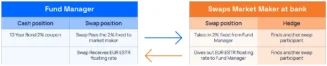
Illustrative Example for exposure for Fund Manager
Fixed = +2% from bond, -2% out to Swaps Market Maker = Fixed rate exposure removed
Float = + Floating rate exposure that goes up or down depending on ESTR movements (Proxy hedge for Inflation)
Typical uses of Interest Rate Swaps are used by many types of end users. These include traditional Fund Managers, Hedge Funds, Risk Managers, Treasury functions and Banks.
Use Cases for Fixed vs Floating Rate Swaps
Interest rate swaps are used by a range of market participants, including asset managers, corporate treasuries, banks, and financial institutions. Their applications include hedging, balance‑sheet management, and speculative positioning. In all cases, swaps can generate gains or losses, depending on how interest rates evolve.
Portfolio management/Risk Management
Portfolio managers may use interest rate swaps to adjust portfolio sensitivity to interest rate movements without trading underlying cash securities. While swaps can provide flexibility, they also expose the portfolio to:
- Adverse market movements
- Ongoing margin and collateral requirements
- Valuation volatility
For example:
- A payer swap (pay fixed, receive floating) may benefit if interest rates rise, but will generate losses if rates fall.
- A receiver swap (receive fixed, pay floating) may benefit if rates fall, but will incur losses if rates rise.
Achieving similar exposure changes through cash bonds may involve different costs and constraints, but swaps should not be assumed to be cheaper or lower risk. All associated costs, including bid‑offer spreads, collateral funding, and potential unwind costs, must be considered.
Speculation Using Interest Rate Swaps
Interest rate swaps may also be used for speculative purposes, where there is no underlying asset or liability being hedged.
In these cases, investors take a directional view on interest rates, accepting the full risk of adverse market movements. For example, an investor expecting long‑term rates to fall may enter a receiver swap. If rates rise instead, the position may result in significant mark‑to‑market losses and margin calls.
While swaps typically require limited initial cash outlay, this does not reduce risk. Losses can exceed initial expectations, particularly during periods of rapid or volatile rate movements. Speculative use of swaps therefore requires robust risk management, liquidity planning, and an understanding that outcomes may be unfavourable.
Corporate Treasury Departments
Corporate treasury teams may use interest rate swaps to manage exposure arising from long‑term borrowing. For example, a company with fixed‑rate debt may choose to receive fixed and pay floating under a swap to introduce floating‑rate exposure.
Such strategies can alter interest expense profiles, but they do not guarantee lower funding costs. If floating rates increase, the company’s interest expense may rise, potentially increasing financial strain. Swap usage also introduces counterparty risk, collateral requirements, and accounting considerations.
Mortgage lenders and Banks
High‑street banks and mortgage lenders commonly use interest rate swaps to manage asset‑liability mismatches.
Mortgage lenders often issue long‑dated mortgages (25 years or more) that are floating rate over their lifetime. However, to attract customers, lenders frequently offer an initial fixed‑rate period, such as the first five years of the mortgage.
This creates a mismatch: the lender holds an asset that is floating rate in the long term, but fixed rate in the short term. To manage this exposure, the lender enters into an interest rate swap with a market maker.
The lender passes the borrower’s fixed payments during the initial fixed period to the swap counterparty and, in return, receives a floating rate. This offsets the fixed‑rate exposure during the introductory period and aligns the lender’s cash flows with its broader floating‑rate asset profile.
Common Risks Associated with Interest Rate Swaps
Interest rate swaps involve material risks, including but not limited to:
- Market Risk: Changes in interest rates can result in adverse valuations and realised losses.
- Collateral and Liquidity Risk: Mark to market movements may trigger margin calls, requiring timely access to liquidity.
- Counterparty Risk: The risk that the counterparty fails to meet its obligations.
- Documentation and Legal Risk: Swaps are governed by ISDA and related agreements, which require careful negotiation and monitoring.
- Accounting and Regulatory Risk: Applying hedge accounting under standards such as IFRS 9 or ASC 815 is complex and subject to ongoing compliance requirements.
Important Disclosures
- Any historical examples or references to past interest rate movements are illustrative only and not indicative of future performance.
- Interest rate swaps may result in losses as well as gains.
- Floating‑rate benchmarks such as €STR, SONIA, or SOFR are not guaranteed hedges against inflation or other economic risks.
- This document is for informational purposes only and does not constitute investment advice, a recommendation, or an offer to enter into any transaction.
Markets We Cover
When tracking swap rates and market movements, market participants need reliable, comprehensive data across multiple tenors, currencies, and rate structures. This is where Parameta Solutions makes a tangible difference.
Our Indicative Data service delivers real-time and historical swap rate data across major currency pairs and tenors. Whether you’re marking positions to market or analysing rate trends, you get access to continuously updated curves that reflect current market conditions. The data covers vanilla fixed-for-floating swaps, basis swaps, and overnight index swaps (OIS), with granular tenor breakdowns from overnight to 50 years.
For documentation and valuation disputes, Evidential Data provides time-stamped, auditable records of market rates at specific points in time. This becomes critical when you need to demonstrate what rate was prevailing at a particular moment – whether for accounting close, litigation support, or regulatory reporting.
The Benchmarks & Indices offering includes proprietary reference rates calculated using robust methodologies. These can serve as contractual reference rates in swap agreements or as independent verification against other benchmark sources.
What sets Parameta Solutions apart is the methodology rigor. Our rates are derived from actual executable prices and transactions, not just indicative quotes, giving you confidence in their reliability for critical decisions like hedge effectiveness testing or collateral valuations.
Need More Information on Swap Rates and Market Data? Speak with our team to learn how Parameta Solutions can support your interest rate risk management strategy.
About Parameta OTC Market Data
Parameta is the exclusive provider of OTC market data from TP ICAP’s leading brokerage brands, including ICAP, Tullett Prebon, and PVM.
We deliver high quality market data, indices, and analytics across interest rate swaps and options, money markets, inflation, FX, energy and commodities.
Our solutions empower buyside companies with trusted insights to support trading strategy development, price discovery, pre and post trade analytics, risk management, and regulatory compliance.
Contact us for more information or to request a data sample.
Disclaimer
© 2026 ICAP Information Services Limited (“IISL”). This communication is provided by ICAP Information Services Limited or a member of its group (“Parameta”) and all information contained in or attached hereto (the “Information”) is for information purposes only and is confidential. Access to the Information by anyone other than the intended recipient is unauthorised without Parameta’s prior written approval. The Information may not be not used or disclosed for any purpose without Parameta’s prior written approval, including without limitation, storing, copying, distributing, licensing, selling or displaying the Information, using the Information in an application or to create derived data of any kind, co-mingling the Information with any other data or using the data for any unlawful purpose of for any purpose that would cause it to become a benchmark under any law, regulation or guidance. The Information is not, and should not be construed as, a live price, an offer, bid, recommendation or solicitation in relation to any financial instrument or investment or to participate in any particular trading strategy or constituting financial or investment advice or a financial promotion. The Information does not constitute a public offer under any applicable legislation or an offer to sell or a solicitation of an offer to buy any securities. The Information is not to be relied upon for any purpose whatsoever and is provided “as is” without warranty of any kind, either expressly or by implication, including without limitation as to completeness, timeliness, accuracy, continuity, merchantability or fitness for any particular purpose. All representations and warranties are expressly disclaimed, to the fullest extent possible under applicable law. In no circumstances will Parameta be liable for any indirect or direct loss, or consequential loss or damages including without limitation, loss of business or profits arising from the use of, any inability to use, or any inaccuracy in the Information. Parameta may suspend, withdraw or modify or change the terms of the provision of the Information at any time in its sole discretion, without notice. All rights, including without limitation intellectual property rights, in and to the Information are, and shall remain, the property of IISL or its licensors. Use of, access to or delivery of Parameta’s products and/or services requires a prior written licence from Parameta or its relevant affiliates. The terms of this disclaimer are governed by the laws of England and Wales.